Pathways to Belonging

Pathways to Belonging is a card-based tool designed to be used for training purposes in theological education.
It was designed by Ed Olsworth-Peter and Allison Fenton with artwork by AP Knowhow.
It is adaptable for 1-to-1 use as a coaching tool in tutorials and the discernment process.
Pathways to Belonging is designed to be used alongside guidelines for good practice in the formation of neurodivergent ordinance and ministers in training.
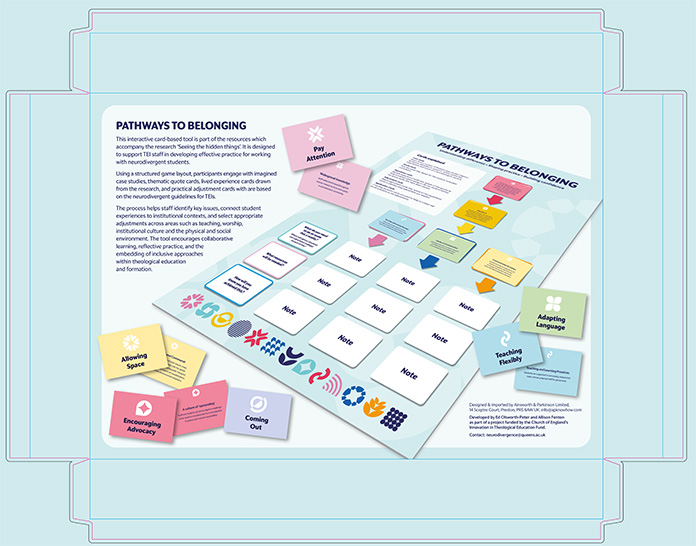
So we wanted to explain how to use Pathways to Belonging. It’s an interactive tool that is based on the research “Seeing the Hidden Things,” and it’s designed for people to use this as a way of engaging with the research to think about practical adjustments that could be used um to um help neurodivergent people.
So, we suggest you lay out the board game as we’ve done so here on this table with the board in the middle, with the six quote cards here and then the relating six experience cards next to them. And uh we’ve also got this instruction booklet so that if you get stuck, this tells you what there is, how to work through it.
And uh we’ve got the case studies. So, there are enough case studies. Um there’s uh six of each copy of the case study and there are adjustment cards summaries here and these are the adjustment cards. So there’s uh different numbers of each pack, but we’d recommend that you set them up like this uh at the side in each category. Uh and we’ll explain we’ll explain what to do with them in a minute.
So, as we already heard, everything you need is in the instruction booklet, but this is a kind of a summary of what you could do. So, take a case study and turn it over and um read through if you’re doing this as a group, which we’d recommend with a few people. Someone reads through the case study and everyone can read along with their own copy. And then looking at what is said, um think about what is something that is at the heart of what is going on for this particular person. And by doing that, you then um hand out the quote cards and you want to sift them through and think about what key areas might be represented here. So maybe it’s around um spirituality. Perhaps there’s a theme around finding worship difficult. So you’d look through the quote cards which are here as a group.
So would we share them out?
Yes.
So you’d give three or four to each person?
Yep. And they’d read them uh read them, sift through them themselves, and then kind of say maybe, “Oh, this one is particularly pertinent.” So, you’ll end up with two or three, won’t you?
Yeah. And the idea is then to decide which one you want to look at, and there may be multiple options, but when you’ve decided as a group which quote card you think best speaks for the experience, you’d place it in the quote box up here. Then once you’ve done that, you would take the corresponding yellow experience card. So in this case, the person’s chosen uh spirituality. So you take the yellow spirituality cards and in the same way you would share them out and you’d look at which card um best describes um what is going on, what speaks for the quote. And you choose one and you place it in the experience box like that.
And actually it’s the conversation about in the choosing that is really important to this. So it’s not a race and uh it’s really about um staying in the process really.
Uh the next thing you would do is uh find some adjustment cards. So uh this is about spirituality and this one says, “At times sounds, words and symbols can help different types of neurodivergence.” And then we’d look through. So there these different categories of adjustment. I think uh well we know that it won’t be reporting clearly for that one. We think it’s probably not about advocacy. It might be about space. It won’t be about transition. Probably isn’t about coming out, which is about uh identity and diagnosis. Um it might be about worshiping together. It won’t be about teaching flexibly.
So I think it probably in those four packs we’d find one together. Say it was the worshipping together one, again we do the similar sort of things we’ve done before: we’ll share them out, we’ll have a look at them, and we’ll decide which ones we think are relevant. So we might get one or two which are relevant from that pile and then we’ll go, “Okay, well let me have a look at this and see if there’s anything in one of the other categories.” Again, share them out, discuss them. You might get one or two again, um and you can keep going with that.
So we might end up with um four or five and then we need to narrow that down. So as in part of the conversation, we’ll narrow it down for the adjustments: which is vital, which is important, which is helpful.
And what is helpful as well are the adjustment card summaries, aren’t they? So there are shorthand on two sides which give you an overview of what was on all of those cards because there’s a lot of cards. So you also might want to look through those to help to narrow down what you might want to look at.
So I’ve got three quite randomly there. Um in if in real time that would have taken much longer. We put them in uh vital, important, and helpful.
And then once you’ve identified those cards, you work with them and you use these three questions here. Um, in the game you’ll be given um sticky pads that fit onto here that you can write on. Um, you could also use pieces of paper to place on the board. We’d recommend you don’t write directly on the board, otherwise you can’t use it again, but you’d place them on here. Um, and with each of these cards, you’d work through. So, with the vital card here, which—Allison, read that out.
Oh, it says, “Diverse practices, students are offered choices in worship, which include structure and more self-directed approaches to prayer.”
So you’d look at that and you’d say, “Okay, what do you need to make this a reality? Um where will agency and adjustment be part of this?” So agency is around how can we help the student um to feel more empowered um to find what they need and to speak out what they might need, but also where can the college make adjustments so that this um can address some of the issues that have been found? And you’d write it on your note here.
Then the next, having thought about that, you’d then ask, “What resources might be needed? What do we need to do as a college?” It might be skills, people, time. You might need to buy something; it might be um a practice of some kind. You’d write that in there.
And then after that, you’d ask of those two things, “How will you know you’ve achieved this?” So, it’s trying to feature think to think if we put these things in place, um what would we want or anticipate the difference to be in the experience of the student?
And then you keep working through that one, two, three times. Um don’t write too much on these notes. You know this needs to be practical and it needs to be achievable. So there’s a little bit of dreaming involved in this—I know that uh—but also we need to be a bit practical, and then maybe at the end you take a photograph of it and um and there you have it as a record.
Now we said at the beginning that there might have been two or three quote cards. You can repeat this again and again as many times as you want to.
Yeah. And within the case study—so in that case, there might have been a few quote cards that relate to that one part of the case study—there’ll be lots of other themes that come out of that case study and the others that we have. So there’s quite a lot of variables and opportunities to run this in all sorts of different ways.
So we think this is a good training opportunity to use again and again with staff members, but it could be used uh with groups of students or with individual students. Uh the quote cards might give an individual student some help in articulating what they’re experiencing. So, uh, we hope you enjoy it.
Yeah.
How to use Pathways to Belonging
In this instructional video, Allison and Ed introduce Pathways to Belonging. They demonstrate how to use its components to analyse case studies and identify adjustments for neurodivergent people.
Coming soon: Case studies and instructions
Please check back to this page later for case studies to use with Pathways of Belonging and instructions on how to use the tool.
Need support using Pathways to Belonging?
Both Allison Fenton and Ed Olsworth-Peter are available to offer in-person training in using this card-based tool.